Over the last few weeks, I’ve been using Midjourney to bring a few of my ideas to visual life. While I was content with the results, I couldn’t help but feel like something was off viscerally. I’m still struggling to sharply articulate what I felt. It had textures of unfairness, inauthenticity, and injustice, as if some instinct was pushing back against the idea that these images counted as real art.
At the same time, I was also able to see genuine meaning in my creations, even though I was only partially responsible for their existence. This internal conflict between the unconscious unease and the joy of discovering meaning got me curious enough to explore this in more depth. I’m certain other people have felt these sensations too, both as someone making AI art and as someone consuming it. And notably, these sensations are absent with respect to creating and consuming human-executed art.
To work through this, I found it useful to define what art is and the systems of creation and consumption at a human level. Then I compare traditional art and AI art along those same dimensions, and finally try to articulate what feels off about AI art and whether that reaction is justified.
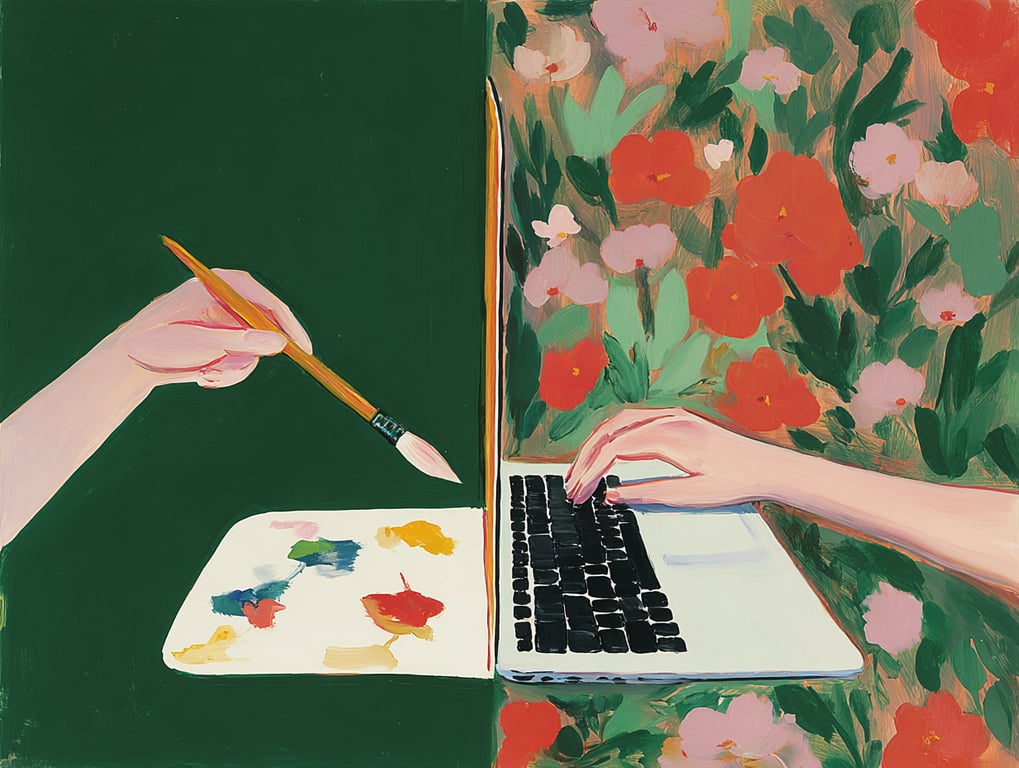
Defining Art
There could be many definitions of art. The one I arrived at is this: Art is a creative manifestation of a story from the medium of thought to a different one. Examples include paintings, songs, movies, books, photos, and so on. All of these involve a creator who uses their agency and skills to bring about this transformation. In doing so, the artwork encodes the story as the creator envisioned it. Because the creator encoded the story, it also needs to be decoded, and that task falls upon the consumer.
It is also worth noting that art exists on a spectrum of human involvement, ranging from purely human-made to fully AI-generated, with human-assisted work sitting in between. That middle ground is what interests me most for this essay: humans using AI as a tool to realize a vision.
How Art Is Created: The Encoding System
The system of creation involves several core components.
- The story in its origin medium, the mind, where it exists as a network of connected and disconnected memories. Its raw material comes from lived experience and the content the creator has absorbed.
- The transformation of those story fragments into a coherent narrative. Sometimes this is pre-planned, but more often it is discovered during creation itself. Creators constantly react to what they’ve produced so far, and the output at each stage feeds back into the story and its transformation.
- The compression factor of the story as it moves from mind to medium. This depends on the medium of expression (paintings have very high compression factors compared to books) and the creator’s intentional level of abstraction. Some abstraction tends to be more interesting than none, but extreme abstraction becomes difficult to decode. This balance is shaped by the creator’s awareness of their audience and their personal desires.
- The labor of bringing the transformed story to life, including the physical and cognitive effort, the time required, and the chosen medium.
- The gap between the envisioned work and the final result, influenced by the creator’s skill, experience, and practical time constraints.
How Art Is Consumed: The Decoding System
On the consumption side, several forces shape how a person receives and values a piece of art.
- Sensory Access
The process begins with simple exposure. A person encounters the final form of the work through sight, sound, touch, or some combination of senses. Without access, nothing else follows.
- Visceral Response
Next comes the immediate, instinctive reaction: the raw sensory feeling the work evokes. A consumer may feel moved, unsettled, delighted, or indifferent before they can articulate why. The story embedded in the work may contribute at a subconscious level, but at this stage the response precedes interpretation.
- Interpretation
After the initial reaction, the consumer attempts to make sense of what they are experiencing.
This process depends on:
- the consumer’s fluency in the medium
- their personal world model shaped by lived experience
- the compression density of the original story
- the creator’s skill in expressing that story through the chosen form
Interpretation is where meaning is actively constructed, a negotiation between what the creator encoded and what the viewer is equipped to decode.
- Creator Context: Story and Labor
The final dimension of value perception concerns the creator themselves, and three forces are especially important here.
-
Status of the Creator
High-status creators benefit from a halo effect, with audiences working harder to extract meaning and aligning their judgments with social expectations. Over time, they may internalise admiration that initially began as social conformity.
That said, some viewers gain status by discovering unknown creators, which can counterbalance the advantage of fame.
-
Perceived Labor
People tend to value work more when they believe it required significant effort, and the more visible the sacrifice, the greater the perceived value. Human psychology elevates hard work and perseverance over efficiency.
-
Life Circumstances of the Creator
Audiences often factor in a creator’s background when judging their work. A big part of how they assign value comes from the gap between what someone produces and the resources they had available.
This has two practical implications. First, creators with fewer resources may be judged more generously even when their output is modest in scale. Second, if those same creators manage to produce something ambitious despite their constraints, the perceived value of their work can rise disproportionately.
These four stages don’t always unfold in a clean sequence. The creator’s story and labor often act as a priming layer that colors everything else. When a consumer knows before engaging with the art that it was AI-generated or painted over ten years by a reclusive artist, that knowledge shapes the visceral feeling, the interpretation, and even what they pay attention to.
Comparing Traditional Art and AI Art: Creation
With this framework in place, we can compare how traditional and AI art stack up across each sub-system of creation.
- The Original Story
The story comes from the same place in both cases: lived experience, absorbed ideas, and memory. Whether you use a paintbrush or Midjourney, you’re drawing on your imagination. In fact, AI will widen the range of stories that get told. Many ideas go unheard not because they lack depth, but because the people who hold them lack technical skill or time.
- The Transformation of the Story via Thought
The cognitive work of shaping scattered ideas into a coherent story involves the same kind of thinking in both modes. A painter revises sketches and experiments with color. An AI creator iterates on prompts and responds to outputs in much the same feedback loop.
AI tools can also enrich the transformation process. An LLM or image model may introduce compositions or aesthetic directions the creator hadn’t considered, functioning like a collaborator that expands the thought space. The creator’s job shifts from pure generation to generation-plus-curation: steering, selecting, and refining from a larger field of possibilities.
- The Compression Factor
Compression, the degree to which the full story in the creator’s mind is distilled into the final work, becomes more flexible with AI. Because each iteration takes little effort, creators can test different levels of abstraction and choose what best serves the story. In traditional art, compression is shaped by both intention and constraint.
With AI, those limits largely fall away, making compression a more purely creative choice. The same story can be rendered as a single evocative image, a detailed illustrated sequence, or an immersive visual world, all by the same creator.
- The Physical Labor and Time to Create
The deepest difference is in effort and time. Traditional creative work requires sustained practice and long hours, often over years. AI compresses this almost entirely. But what matters is what the low labor cost enables: rapid iteration, bolder experimentation, and a shift from execution to vision, selection, and refinement, which are real cognitive skills even if they are less physically demanding.
- The Gap Between Vision and Output
In traditional art, there is often a wide gap between what someone imagines and what they can produce, especially early on. With AI, that gap shrinks. The system already has extensive capability, and rapid iteration lets people refine results until they closely match what they envisioned.
Comparing Traditional Art and AI Art: Value-Perception on the Consumption Side
Now, how does value perception change on the consumption side?
- Sensory access is unchanged. Your eyes and ears work the same way regardless of how the art was made.
- Adaptability and compression density are where AI art introduces something new. Traditional art is fixed once made: it exists at whatever level of abstraction the creator chose, and the consumer either meets it or doesn’t. AI art can be fluid. The same story can be re-rendered for different audiences, tailored to a viewer’s world model, or adjusted in density, all at minimal cost. This makes the decoding process less dependent on the consumer’s fluency in the medium.
- The visceral response is where things get genuinely interesting. AI art can trigger more inputs of awe simultaneously: novel aesthetics, richer detail, unfamiliar compositions, and sheer volume. But this cuts both ways. If the consumer knows the work is AI-generated before encountering it, that knowledge functions as a priming layer that dampens the very awe the work might otherwise produce. The visceral response isn’t purely about the object. It’s contaminated by context.
- The creator’s story is where the gap is widest. Traditional art carries the weight of visible sacrifice: years of practice, physical endurance, the romantic narrative of the struggling artist. AI art offers almost no labor narrative for the consumer to latch onto. Since perceived labor is one of the strongest drivers of value perception, this reshapes the entire evaluation.
Status will likely shift over time as AI artists build reputations, but the deeper issue is structural: the values of hard work and perseverance are deeply embedded in how people assign worth, often overriding beauty or story. This means AI art faces a perception penalty that has little to do with the art itself and almost everything to do with what the consumer believes about the process behind it. The art could be identical in every sensory dimension, but the story of its making, or the absence of one, changes what people feel it’s worth.
How AI Changes What Artists Can Do
Based on the comparison above, we can identify several key benefits.
- A wider range of stories can be told, since AI brings together more skills than any single human artist, allowing ideas to be realized that once went unexplored because the right talent wasn’t available or interested. People with rich inner worlds but no formal artistic training can now produce work close to what they envisioned.
- The transformation of a story can be richer, because AI may add details the prompter wouldn’t have thought of on their own, and because the process requires relatively little physical labor or time, the prompter can refine and expand through multiple iterations.
- The same story can exist at different levels of complexity, expressed in simpler or more layered forms to meet audiences where they are, re-rendered and adjusted in density at minimal cost.
- Artists can experiment more freely, taking bolder risks when the cost of experimentation is low, trying things they would never attempt if the stakes were higher.
So What Actually Feels Off?
Let me return to the core question: what exactly is the source of that discomfort around AI art? Two things stand out.
- First, creation feels more off than consumption. Consuming AI art, if anything, can feel exciting. The novelty and sheer range of what it can produce often evoke richer, more visceral reactions than traditional art does. The unease lives almost entirely on the creation side.
- Second, building an identity around AI art creation feels off. This, I think, is where the real tension lies. We tend to ascribe deep value to the physical labor of making art: the years spent developing skill, the suffering endured, the countless iterations of bad work before anything good emerges. That process is part of what gives art its weight, both for the creator and for the audience.
AI art bypasses nearly all of that. What once required years of cultivation can now be produced with a fraction of the effort, and often to a higher technical standard. So when someone shares AI art and positions themselves as a creator, it triggers something like a fairness instinct. The reaction isn’t mainly about the quality of the work, but the effort behind it. For a long time, creative status has been linked to time spent practicing, failing, and slowly improving. Tools that compress that timeline break the implied contract. The work appears without the visible costs that usually justify recognition. To many people, that feels like cutting ahead rather than earning a place, even if the result looks impressive.
Why This Discomfort Is Misplaced
The unease around AI art only holds up if you believe the most important purpose of art is to signal the manual toil behind it. And that is not the purpose of art.
For the creator, the purpose is to have the means to tell a story, the ability to get better at the craft, the joy of going through the process, the ephemeral happiness of the finished product, and the pride of a job well done. Using AI to create checks all of these boxes. It allows existing artists to tell more stories in novel ways, and it allows a new breed of artists to exist for whom the tools are natural-language-based prompting instead of analog or digital craft. The instrument changes. The creative impulse does not.
For the consumer, the primary purpose is to be moved by the act of consumption. This is anchored first on the story, its representation, and their interpretation of it. The scaffolding of manual labor only enters the picture later. In other words, value creation and derivation matter more than value perception. People want to be overwhelmed by beauty, not by the process behind it.
Sure, the world will have purists who insist that meaning cannot exist without struggle. But that is a bias, not reality. A randomized blind study presenting both AI and traditional art, then asking participants to judge how emotionally moving each piece is, would likely show AI art performing comparably or better.
Technology has repeatedly unlocked new ways of creating art, and each time, people resisted.
- Photography replaced many paintings, but it also created entirely new art forms that could never have been painted: selfies, candid moments, perfectly natural representations of the world. The market for photography grew far larger than painting ever was. And while paintings became scarcer and more valuable per piece, the sheer volume of photographs that came to exist dwarfed that difference in price. The total creative output expanded enormously.
- Graphic design followed the same pattern with print design. It required less manual labor, yet it overtook the market because it enabled more stories to be told, and told better, while being native to the medium where people were increasingly spending their time.
In both cases, the newer form was initially dismissed for lacking the craft of what came before. In both cases, it won because access, volume, and storytelling potential mattered more than the labor involved. AI art is simply the next chapter in this pattern.
My prediction is that AI art follows this familiar arc. Because there will be far more of it, there will be far more storytelling and far richer representation than traditional art could produce alone. We will pass through a phase where it is dismissed or looked down upon. But over time, the culture will arrive at the understanding: the story and its representation matter more than the labor required to make them.